
You see this happen a lot in state agencies: the IT team starts using Assist. Then a program office launches an AI chatbot for people’s questions. The HR department begins using a third-party tool to create job descriptions. A developer builds a custom integration to summarize cases.
Each of these things might be useful on its own. The problem is that they do not work together. They do not share a plan for how to govern them. Nobody has a list of what is being used, what data each tool is touching or whether any of it is actually making things better. Then the legislature asks the CIO for a report on AI usage across the agency. The answer is a spreadsheet that was put together from emails.
This is what we call shadow AI proliferation. It is not a theory. It is what happens when AI is adopted without good governance. It is exactly the problem that ServiceNow’s AI Control Tower is designed to solve.
What AI Control Tower Actually Is
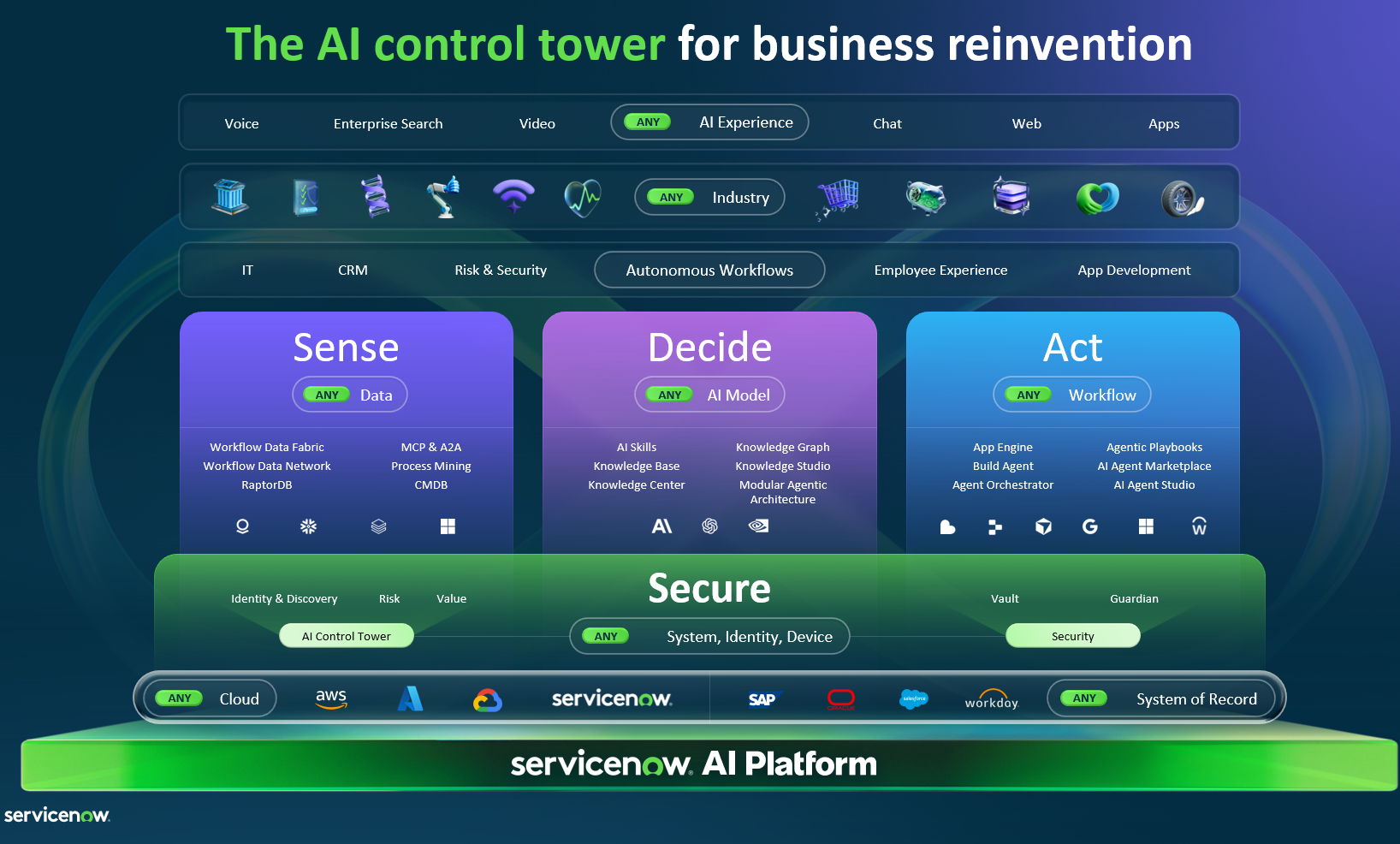
AI Control Tower was introduced at Knowledge 2025. It is now available to everyone. It is a way to govern and manage AI assets across the ServiceNow environment and it also supports third-party environments. It is not another model and it is not a single workflow. It is the management layer that sits above your AI investments and gives your organization visibility, control and accountability across the ecosystem.
At its core, the platform does four things. It keeps a list of all AI assets, including models, agents and workflows. It shows how these assets support business services. It provides real-time dashboards that connect AI activity to business outcomes. It helps enforce governance policies and risk controls including requirements tied to executive orders and regulatory mandates across the full AI lifecycle.
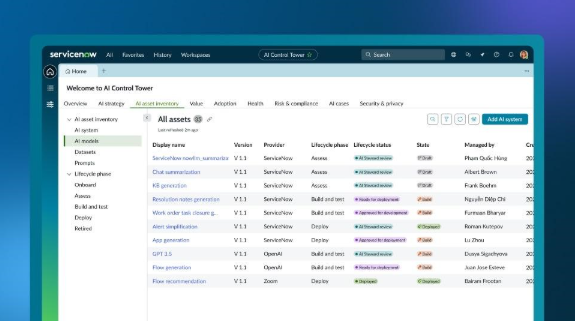
The AI asset inventory in Control Tower provides a live registry of every model deployed across the enterprise, including third-party systems such as OpenAI’s GPT-3.5. Lifecycle phase, deployment status, and assigned steward are visible at a glance.
The AI Agent Fabric is another feature to understand. It supports communication between agents and models. As agencies move from AI deployments to coordinated workflows, where specialized agents work together across a process, Agent Fabric provides the connective tissue for that orchestration to happen in a governed and auditable way. Think of Control Tower as the management console and Agent Fabric as the network layer underneath it.
Because Control Tower is built on ServiceNow’s AI Platform it benefits from the existing architecture. For organizations using ServiceNow for critical services this is a major advantage: Control Tower can use existing data to understand the business context of each AI asset. For organizations with inconsistent data this becomes a readiness issue.
Why This Matters for Government
State and local government IT teams face pressures that make AI governance more than just a good idea. In the sector, it is quickly becoming essential.
Start with accountability. Sector AI governance is often self-directed. Government agencies on the other hand face audit requirements, legislative oversight, public records expectations and executive mandates that require documented evidence of how AI is being used, what data it can access, and what guardrails are in place. Federal agencies have been required to maintain AI use case inventories since 2019 and state governments are moving in that direction. A registry inside Control Tower gives agencies an auditable system of record instead of another manually maintained spreadsheet.
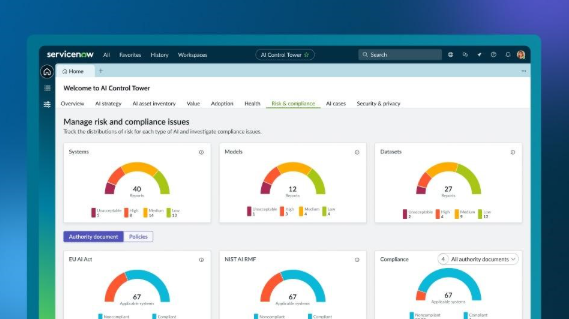
The Risk & Compliance view tracks AI systems, models, and datasets against named authority documents, including the EU AI Act and NIST AI RMF. That creates the kind of auditable evidence state legislatures and oversight bodies increasingly expect.
Then there is trust. When AI influences a decision that affects people, such as benefits or permit approvals, the expectations are different. Agencies need to be able to explain how decisions were made, have oversight, and keep a clear record of how decisions were supported. Control Tower’s ability to assign managers to AI agents enforce oversight guardrails and track decision trails is not a nice-to-have in government. It is necessary.
Finally, there is budget accountability. State IT investments are challenged in ways that corporate budgets often are not. Control Tower’s ROI measurement capabilities help CIOs connect AI performance to outcomes that matter, such as faster case resolution, lower cost per transaction or staff hours returned to mission work. Those are the numbers that hold up in appropriations conversations.
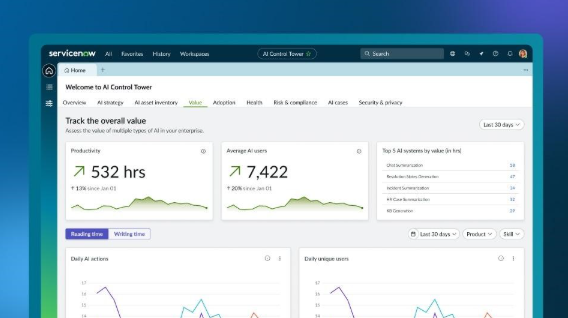
The Value dashboard translates AI performance into the language CIOs need: productivity hours recovered, active users, and a ranked view of which AI systems are producing measurable return.
Setting Up for a Successful Implementation
AI Control Tower delivers the most value when it is rolled out as an enterprise capability not just installed as another tool. The dependency chain includes AI Control Tower Core, AI Asset Management and AI Risk and Compliance as required plugins. Installing, configuring and integrating these capabilities with an existing ServiceNow instance is an effort that benefits from an implementation partner who knows both the platform and the public sector environment.
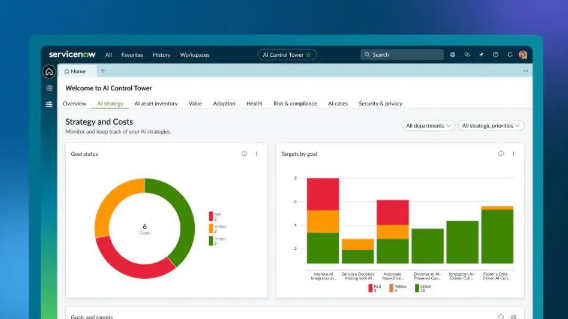
The Strategy & Costs view turns AI initiatives into a portfolio of trackable goals, with red, yellow, and green status against strategic priorities. It shows the destination most agencies are trying to reach when they invest in Control Tower.
The value of Control Tower depends heavily on the quality of the data underneath it. A current, well-maintained CMDB gives teams accurate asset-to-service mapping from day one. For agencies whose CMDB needs work, a Control Tower deployment can become the catalyst for improving that foundation. The two efforts can be run in parallel.
The business case should also be grounded in value. What is the cost of AI risk? How much staff time is currently spent on compliance reporting? What is the reputational exposure of a high-profile AI failure in a public-facing system? Agencies that frame the investment around questions like these usually find that the math is easier to defend.
Are You Ready? Five Questions
Is your CMDB accurate and current? Control Tower maps AI assets to business services through the CMDB, so a current CMDB makes that mapping accurate from day one. If yours needs a refresh, that work can run alongside deployment rather than blocking it.
Do you have a named AI governance owner? Control Tower needs someone to own it: a Chief AI Officer, an AI Steward, or a designated leader within the CIO’s office. A named owner turns the platform from a dashboard into an active governance function. Who has the authority and mandate to enforce AI governance policies across program offices?
Can you inventory your current AI deployments today? Before you implement a tool to manage AI assets, you need to know what you have. If you cannot produce a reasonably complete list of AI tools, models, and integrations currently running in your environment, including the ones IT did not formally approve, discovery should come first.
Is your ServiceNow instance on a supported release? AI Control Tower runs on current platform versions. If your instance is several releases behind, an upgrade may need to be part of the readiness path. A strong implementation partner can help sequence that work into the overall plan.
Have you defined what “governed AI” means for your agency? Technology can enforce policies, but it cannot write them. Before Control Tower can do its job, your agency needs documented answers to questions such as: Which AI uses require human review before action? What data categories can AI models access? What counts as an AI incident, and what is the response protocol?
The Bottom Line
AI Control Tower is an answer to a real and growing problem. Shadow AI proliferation, audit exposure, fragmented governance and the inability to demonstrate ROI are not theoretical concerns for state government IT. They are active risks that will compound as AI adoption accelerates.
Control Tower is a platform, not a shortcut. Agencies that treat it as a checkbox will get a checkbox. Agencies that treat it as an investment, supported by a reliable data foundation, clear governance policies and the right implementation expertise can gain real command over their AI ecosystem.
Servos has been implementing ServiceNow for state and local government since before AI Control Tower existed. We understand the database dependencies, the integration work and the governance realities that public sector agencies face. If you are trying to determine whether you are ready for Control Tower or what it would take to get ready that is the kind of conversation we are built for.

Pat Snow serves as Vice President of State and Local Government Strategy at Servos, following his retirement as CTO of the State of South Dakota in June 2024. During his 28-year career in state government, Pat established South Dakota as a national leader in consolidated IT infrastructure and digital service delivery. At Servos, he continues to drive digital transformation in the public sector, helping agencies deliver more efficient and accessible services through the ServiceNow platform.